
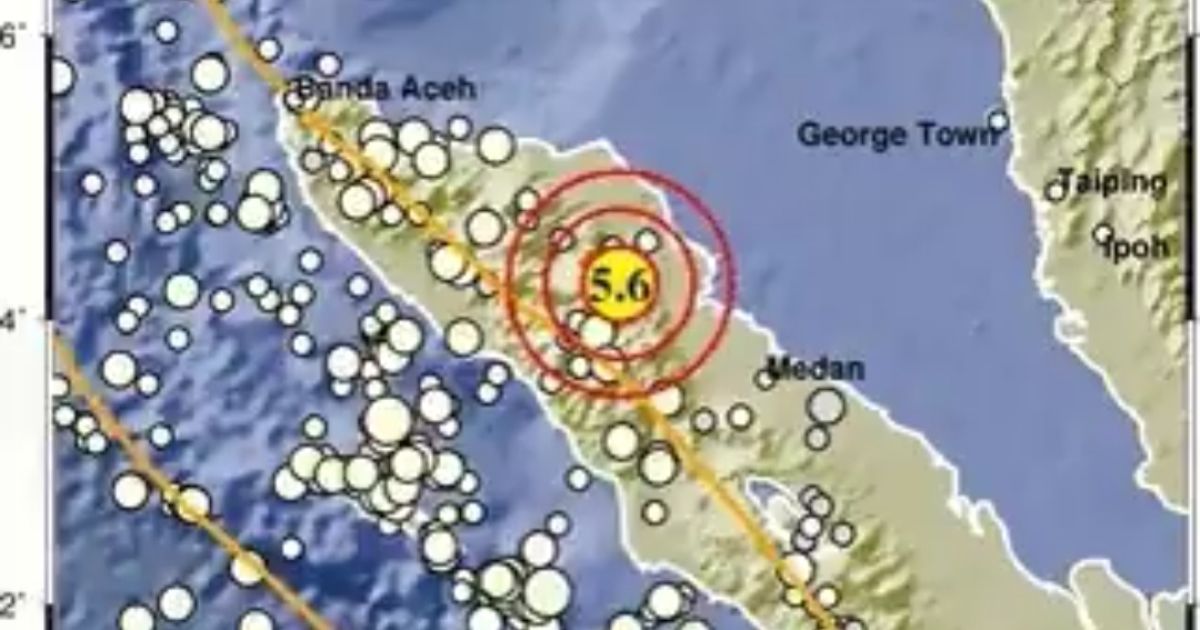
Aceh — A magnitude 5.6 earthquake struck Gayo Lues district in Aceh province at 11:18 a.m. local time on Wednesday, 22 July 2026 shaking areas across northern Sumatra as far as Medan, Indonesia's Meteorology, Climatology and Geophysics Agency (BMKG) said. No damage or casualties had been reported as of Wednesday afternoon.
The quake's epicenter was located about 41 kilometers northeast of Gayo Lues, at coordinates 4.25 degrees north latitude and 97.62 degrees east longitude, with a depth of 10 kilometers, according to BMKG. The agency said the earthquake occurred on land and carried no tsunami risk.
Andi Azhar Rudin, head of BMKG's Aceh Besar Geophysics Station, confirmed the quake's timing and characteristics.
"This earthquake, with a magnitude of 5.6, occurred at 11:18 a.m. local time," Mr Andi said. He said the shaking was felt across several Aceh districts, including Southeast Aceh, Southwest Aceh, North Aceh, Lhokseumawe, East Aceh, Bener Meriah and Central Aceh.
"It was also felt as far as Medan, Deli Serdang, Sibolga, South Aceh, Aceh Tamiang, Lhokseumawe, Langsa, Pidie and Pidie Jaya," he said.
Mr Andi said his office had contacted the local disaster management agencies in Gayo Lues and Central Aceh, both of which reported no impact from the quake so far. "Until now there is no information about damage in Gayo Lues or Central Aceh, but it was felt very strongly," he said.
BMKG assigned the earthquake a maximum shaking intensity of V on the Modified Mercalli Intensity scale in Gayo Lues, with lower intensities of II to IV recorded in surrounding areas including Medan, South Aceh, Southwest Aceh and Sibolga. In Blangpidie, Southwest Aceh, resident Rahmat said the shaking caught him off guard. "It's true, we felt an earthquake just now," he said.
Febri Simanjuntak, a forecaster at BMKG's Malikussaleh station, said the quake would not trigger a tsunami and urged the public to remain calm and avoid unverified information. BMKG recorded the quake as the strongest to hit Indonesia in the past week and said it continues to monitor the area for aftershocks or further activity.