
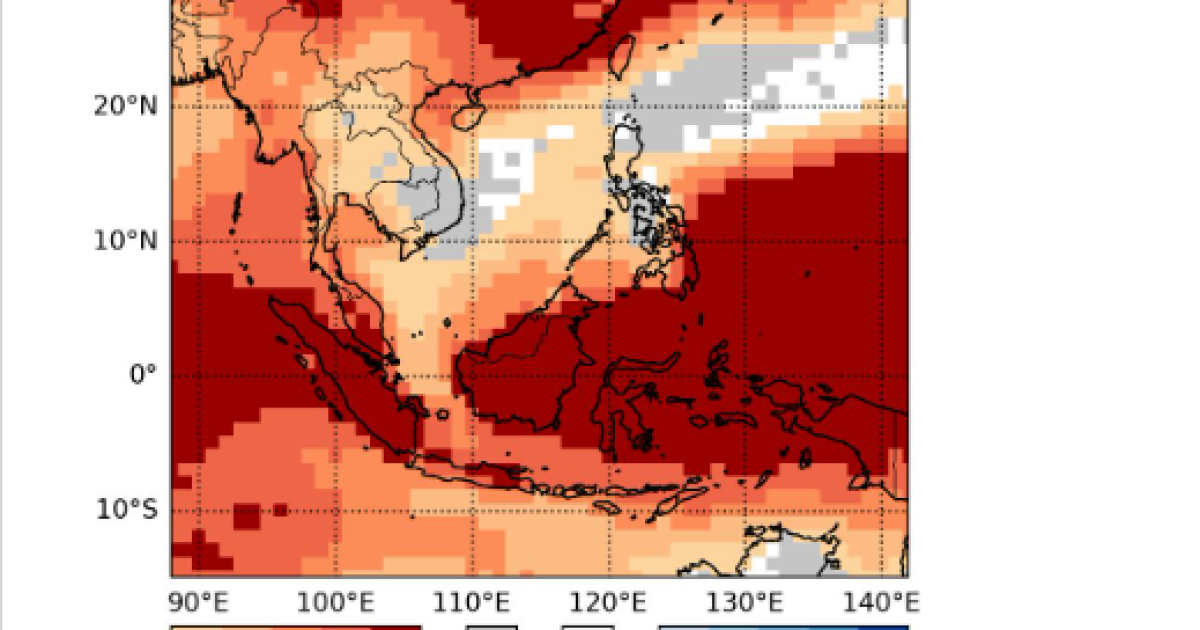
Jakarta - The Association of Southeast Asian Nations' (ASEAN) Specialized Meteorological Centre (ASMC) has forecast that Southeast Asia would face warmer temperatures across one-third of the region in March to May 2026 period.
ASMC' recent imagery temperature shows Indonesia, Malaysia, and Singapore are about to see an 80 to 100 percent chance of above-normal heat, and then is expected to expand to much on Southeast Asia's mainland in the following two months.
The agency also said that the heat would spread against Thailand and northern Vietnam. Besides, only small parts of the region, including southeastern Vietnam, Cambodia, and parts of the Philippines, are forecast to see near-normal temperatures.
"Under the prevailing dry conditions, hotspot and smoke haze activity in the northern ASEAN region is likely to remain elevated, with a heightened risk of transboundary smoke haze occurrence, particularly over the northwestern parts of the Mekong sub-region where below-normal rainfall is forecast," ASMC reported on its seasonal outlook, published on Friday, 6 March 2026.
Related to that, Indonesia's Meteorology, Climatology and Geophysics Agency (BMKG) forecast that the transition from the rainy to the dry season in the country will occur from April to May 2026.
Most regions in Indonesia are expected to gradually enter the dry season from April to June 2026, starting in the Nusa Tenggara region, then spreading to other areas across the country.
“For 2026, rainfall is expected to be below normal, so the dry season is expected to be drier than usual,” said Teguh Wardoyo, head of Data Services and Information Dissemination Task Force at the BMKG Tunggul Wulung Meteorological Station in Cilacap, in Indonesia's Central Java.
BMKG also warned about Tropical Cyclone Nuri, spotted appearing in the Pacific Ocean, near the northern part of the Papua coast, that would trigger increased weather activities in several regions in Indonesia.
BMKG Weather Forecaster Lintang Alya on Thursday, 12 March 2026, stated that the cyclone has maximum wind speeds of up to 35 knots, a minimum pressure of 1,000 hectopascals, towards East to Northeast directions.